15 One Piece Mysteries That Oda Still Has to Answer Before the Final Saga Ends
By ZealPlane Editorial | Senior Pop Culture & Manga Analyst | ZealPlane Chronicles
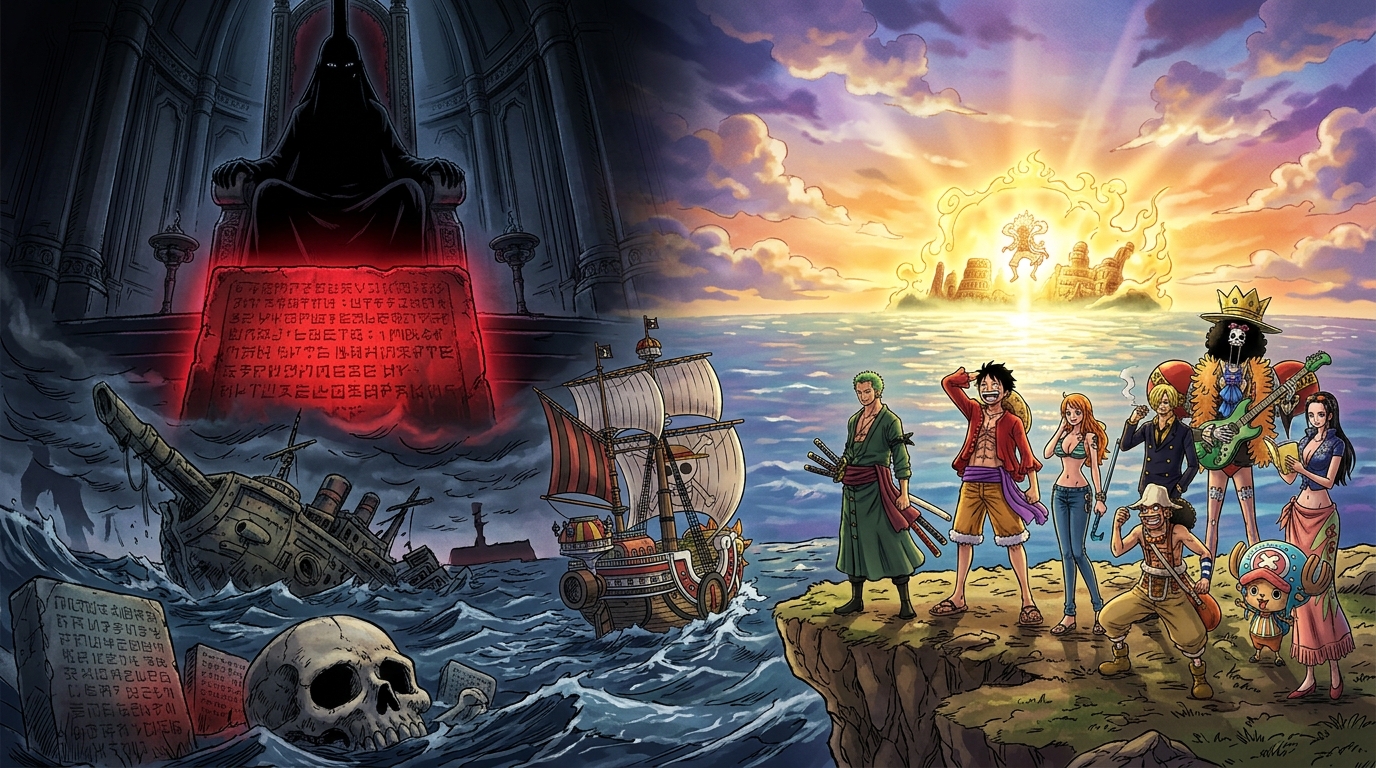
📌 Before you read
- This article discusses major manga revelations through the current Elbaf arc. Major spoilers ahead.
- These are not separate mysteries. By the end, you'll see they all circle back to a single buried truth.
- We've tried to go beyond "what" and actually dig into "why these questions matter now."
Here's the thing about One Piece that no other manga really does: Oda plants a seed in chapter 100, waters it with a throwaway line in chapter 400, and then hits you with the full-grown tree in chapter 1,000. And you feel like an idiot for not seeing it coming — but also kind of genius for having read long enough to witness it.
That patience is exactly what makes the Final Saga feel so different from everything before it.
We're not waiting for mysteries anymore. We're waiting for them to collapse into each other.
Over the last few arcs — Wano, Egghead, and now Elbaf — Oda has been pulling threads that stretch back to chapter 1. The world's ancient history is slowly becoming legible. But a staggering number of questions are still unanswered, and the clock is ticking. So let's actually think through them — not just list them, but ask what they mean and why they matter right now.
1. What Actually Is the One Piece?
I know. You know. Everyone knows this is the big one.
But here's what I find genuinely fascinating: Oda has never played coy about the fact that it exists. It's real. Roger found it. His entire crew wept and laughed in the same breath. That reaction — laughter mixed with grief — tells you something important. Whatever they found wasn't just treasure. It was ironic. It was the punchline of an 800-year-old joke that the world had been living inside.
My best guess? The One Piece isn't a single object. It's probably a collection of things — the Road Poneglyphs, ancient records, possibly the complete history of the Void Century — that together reveal the truth about what the world was supposed to become versus what the World Government turned it into. And that truth, when exposed to the right person at the right moment in history, is what triggers the Final War.
Roger couldn't act on it. He had no army, no Nika, no D. to back him. He just laughed, because he understood — but the timing was wrong.
Luffy is the timing being right.
2. What Happened During the Void Century?
This is honestly the question that everything else feeds into, and it's still terrifyingly incomplete.
We know the outlines. An ancient civilization existed. It was advanced — probably more than anything in the current world. Twenty kingdoms united to destroy it, then rewrote history and called themselves the World Government. They used the Poneglyphs because they couldn't destroy them. They destroyed Ohara because someone got too close.
But here's what still bugs me: the why. Why did the twenty kingdoms fear this civilization so much? It clearly wasn't about military threat alone — if the Ancient Kingdom could build Pluton and Uranus, they had firepower. So why didn't they win?
Vegapunk's final message gestured at something deeper — the civilization made a choice, possibly a sacrifice, to preserve the truth rather than win the war outright. That's haunting. It means their defeat might have been deliberate.
If that's true, the Poneglyphs aren't just historical records. They're a plan that was meant to be discovered exactly now.

3. Who Was Joy Boy, Really?
He started as a name on a fish-man island Poneglyph who apparently promised to raise Noah but couldn't follow through. A historical figure. Possibly a myth.
Then Oda spent 500 chapters quietly expanding him into the most important person who ever lived in this universe.
What I keep coming back to is his relationship with failure. Joy Boy didn't die a victor. He lost. He made promises he couldn't keep. He left behind weapons he couldn't deploy and allies who were punished for following him. And yet — every single Poneglyph is essentially a love letter from his civilization to a future person capable of finishing what he started.
That's not the behavior of a king who thought he was building a legacy. That's someone who fully accepted their defeat and trusted an impossible future anyway.
The question "who was Joy Boy" might ultimately be less about his biography and more about what he understood — specifically, what he knew about the nature of freedom and why it couldn't be forced on the world, only invited.
Luffy, famously, never forces anyone to follow him. They just do. That parallel is not accidental.

4. Who Is Imu, and Why Are They Still Hidden?
Most villains in fiction want power. Imu already has it — and yet has spent 800 years in complete secrecy. That's the detail that nobody talks about enough.
The World Government preaches that the Empty Throne represents the equality of all kings, that no single ruler holds dominion. That principle is literally the founding myth of the current world order. And Imu has been sitting on that throne since before most civilizations in the series existed.
The question isn't really "who is Imu" in a biographical sense. It's what does Imu need that requires this level of concealment?
My instinct: Imu's continued existence depends on the world not knowing the truth about the Void Century. Not because exposure is embarrassing — but because the truth actively threatens whatever Imu is. Whether that's a form of immortality tied to the Ancient Kingdom's defeat, a power that requires the world's consent to function, or something stranger — the secrecy isn't vanity. It's survival.
PRANA! — India's shonen answer to energy-system manga
If you love the ancient power lore of One Piece, you'll feel right at home here. Read ZealPlane's original superhero series free.
Read Chapter 1 Free →5. What Does the "D." Actually Mean?
This is the mystery I've thought about most, honestly, because Oda keeps doing something clever with it: he refuses to let the D. characters be the same kind of person.
Luffy is chaos and joy. Blackbeard is greed and ambition. Roger was romanticism and tragedy. Garp is discipline and contradiction. They share an initial, not a personality. That means whatever the D. represents can't be a simple inherited trait. It's more like a... tendency. A gravitational pull toward certain kinds of choices.
The Celestial Dragons call them "natural enemies of God." That's not an insult — that's a warning passed down for 800 years by people who know exactly what happened to the Ancient Kingdom and who destroyed it.
My read: the D. is the bloodline of the Ancient Kingdom's leaders. Not royalty in the conventional sense, but the ideological heirs to whatever the Great Kingdom believed in — specifically, freedom absolute enough to threaten the controlled world the World Government built.
6. What Is Wrong With Blackbeard's Body?
Okay so this one is genuinely weird and I love it.
Marco said Blackbeard's body is "atypical." He never sleeps. He can hold multiple Devil Fruits without dying. Every single one of these details has been introduced casually and then never explained — which, in Oda's writing, means they're all connected and the payoff is going to be massive.
The leading theory in the community — that Blackbeard has multiple personalities or even multiple souls inhabiting one body — is compelling precisely because it would explain the sleeping (one personality is always "awake"), the multiple fruits (each one tied to a separate host), and the general sense that Teach is somehow plural in a way other characters aren't.
More importantly: if that's true, Blackbeard isn't just a rival to Luffy in terms of ambition. He's a direct dark mirror of Joy Boy's idealism — someone who achieved freedom by consuming others rather than liberating them.

7. What Is Shanks Actually Waiting For?
Shanks is the character I think the fandom consistently underestimates — because he's positioned as a good guy and because Luffy loves him, we tend to assume his motivations are pure.
But look at what Oda has actually shown us. Shanks met with the Five Elders privately. He has a Figarland bloodline connecting him to the Celestial Dragons. He knows more about the current era than he lets on. And he chose — very deliberately — to enter the race for the One Piece right now.
Not decades ago. Not when Roger died. Now.
I don't think Shanks is a villain. But I do think he has information that makes him dangerous in a way that's distinct from any other pirate. He might be trying to control what happens when the truth comes out — not suppress it, but make sure the fallout doesn't destroy the world in the process. That would make him a tragic figure, not an evil one. Someone who loves the world enough to compromise for it.
8. What Are the Ancient Weapons Actually For?
We've been told the Ancient Weapons can "destroy the world." But I think that framing is reductive and probably inaccurate — or at least incomplete.
Consider this: Poseidon isn't a weapon in any conventional sense. She's a person who can communicate with Sea Kings. The destructive capacity is incidental to the relationship. Similarly, Pluton is a ship — a vessel, not a bomb. And Uranus, whatever it is, likely follows the same logic.
What if the Ancient Weapons weren't built to destroy anything but to reshape it? The Red Line and the Grand Line divided the world's oceans into four separate seas. The Void Century civilization may have created these weapons specifically to undo that division — to restore the All Blue, physically unify the world, and eliminate the geographic chokepoints that allow the World Government to control trade and movement.
That's not destruction. That's liberation on a geological scale.
9. Why Does Prince Loki Matter So Much?
Elbaf has been teased since Usopp's backstory in the East Blue. That's over 1,100 chapters of buildup for a single island. When Oda finally arrives somewhere after that much anticipation, he doesn't do it casually.
Prince Loki is chained in the underworld of Warland because of a crime — likely something connected to his relationship with the Sun God mythology or the giant tribe's ancient history with Joy Boy. The giants are older than the World Government. They remember things. And Loki, as a forbidden figure even among them, probably remembers what everyone else was made to forget.
His Devil Fruit and its connection to the Norse-inspired mythology of Elbaf may also explain the giants' historical significance in a way that ties back to the Ancient Kingdom's ideology.
10. Who Is the Man Marked by Flames?
This is the most immediately tactical mystery in the series right now, because it determines who reaches Laugh Tale first.
Hinokizu — the man with the burn scar — allegedly holds the location of the final Road Poneglyph, or protects it in some capacity. Multiple pirate crews are searching for him. His identity has been one of the most debated theories in the fandom for years.
The "marked by flames" imagery is specific enough that it probably connects to a known character. The burn-scar detail feels deliberate in a story where physical marks always mean something — Luffy's scar under his eye, Roger's scar on his chest, Whitebeard's back.
11. What Is the Actual Treasure Hidden in Mary Geoise?
Doflamingo blackmailed the World Government for years using his knowledge of this. He called it powerful enough to "change the world." He was confident enough that he trusted it as a permanent insurance policy.
The most compelling theory is that it's a giant straw hat — stored in a frozen chamber, preserved for centuries — that belongs to Joy Boy. Not a hat like Luffy's. A hat the size of a building. Something that would immediately tell anyone who saw it exactly who Joy Boy was and what he represented.
If the World Government has been literally keeping Joy Boy's symbol on ice in their own capital, the irony is almost too perfect for Oda to resist.
12. What Did Zunesha Do?
This one stays with me because of how quietly it's been handled.
Zunesha has walked the seas for over a thousand years. Alone. Carrying a nation on its back. Under orders it cannot question, toward a destination it cannot reach, as punishment for a crime the story hasn't named.
And then — in Wano — Zunesha hears the Drums of Liberation for the first time since the Void Century and says, simply: "I remember."
Whatever Zunesha did, it was done in the presence of Joy Boy. The punishment was connected to that era. And the fact that Luffy's awakening triggered recognition in an ancient creature who has been waiting a millennium suggests the crime, the punishment, and the reunion are all part of the same long story.
I suspect Zunesha's crime was abandoning Joy Boy when he needed it most. And its punishment — to wander forever unable to act unless commanded — is the literal consequence of that choice.
13. What Is Luffy's Real Dream?
This is the one Oda is most deliberately protecting, and for good reason.
We know Luffy told Ace, Sabo, and his crew. We know Shanks smiled when a child version of Luffy told him. We know his crew laughed and called it ridiculous. All of those reactions suggest it's not a serious political ambition — it's something absurdly simple that somehow contains everything.
The most resonant theory: Luffy wants a world where he can share meat with everyone he's ever met — where the seas are open, the world is one, and no one goes hungry or lives in fear. Not world peace. Not a throne. Just a table big enough for everyone.
Which, when you think about what the Ancient Kingdom believed in, and what Joy Boy promised, and what the Ancient Weapons might actually be designed to do — isn't absurd at all. It's the exact destination the whole story has been pointing toward since chapter one.
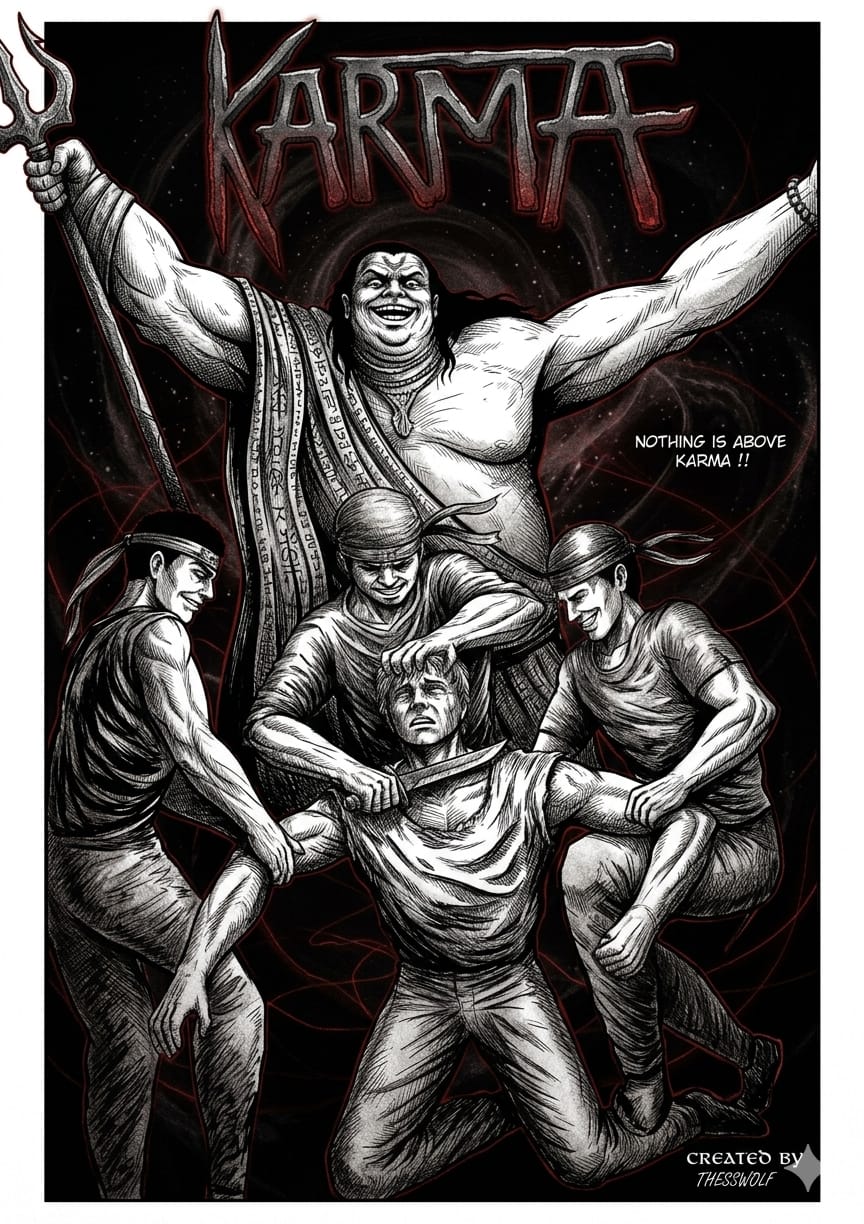
Karma — If you love deep lore and ancient mythology
A dark fantasy story rooted in South Asian folklore with morally complex characters and a layered world. Read it free.
Read Chapter 1 Free →14. What Did the Ancient Kingdom Actually Believe In?
Eight hundred years of suppression doesn't happen because a civilization was militarily inconvenient. You erase a civilization because its ideas are dangerous.
What the Ancient Kingdom seemed to believe — based on everything we can infer from Joy Boy, the D., and the nature of Nika — was that people have an inherent right to be free. Not free under a king. Not free within a system. Just free, full stop.
That's the most threatening possible ideology for a world built on hereditary aristocracy, controlled seas, and a government that literally owns people. The Twenty Kingdoms didn't just defeat an enemy. They destroyed a world where that alternative was possible, and then built a new one where it couldn't be imagined.
Oda has been writing about that buried idea for 27 years. The Final Saga is its resurrection.
15. What Happens When the World Finally Knows?
Whitebeard said it at Marineford, and no one really believed him: "Someone will find the One Piece and the world will be shaken to its foundations." He didn't say there would be a war. He said the world itself would crack open.
I think the final revelation isn't just going to expose the World Government as corrupt. It's going to expose the physical world as artificially constructed — the Red Line, the Grand Line, the divided seas — all of it the product of a war fought 800 years ago, maintained ever since to keep people controllable and separated.
When that truth lands, the Final War won't just be about who controls the government. It'll be about whether the world reverts to what it was supposed to be.
That's enormous. That's the kind of ending that makes you understand why Oda has spent 27 years building toward it.
These 15 Questions Are Actually One Question
The more I sit with these mysteries, the more obvious it becomes that Oda has never been writing 15 separate threads. He's been writing one story with 15 entry points.
The One Piece → Laugh Tale → the truth → the Void Century → Joy Boy → the Ancient Kingdom → the World Government → Imu. Every question feeds into the next. Every character carrying the D. is implicitly part of the same lineage. Every Ancient Weapon points at the same geographic transformation. Every mystery about Blackbeard, Shanks, and Luffy's dream is really a mystery about what kind of world the story ends in.
That convergence is what makes the Final Saga feel different. Not longer. Not bigger. Just — closer. Like you can finally feel the shape of the answer even if you can't see it yet.
For the first time in 27 years, the questions feel like they're running out of road.
And that's genuinely exciting.
A quick reference to all 15 mysteries and their narrative connections:
| # | The Mystery | Why It Matters Right Now |
|---|---|---|
| 1 | The One Piece | The destination of everything — and probably a revelation, not just a reward |
| 2 | The Void Century | The erased 100 years that explains why the world is the way it is |
| 3 | Joy Boy | His failure is what Luffy's awakening was designed to complete |
| 4 | Imu | The hidden ruler who has more to hide than just identity |
| 5 | The Will of D. | Not a bloodline trait — an inherited ideology that refuses to die |
| 6 | Blackbeard's body | The anomaly that breaks the story's rules — which means Oda built it that way |
| 7 | Shanks' endgame | Not a villain, not fully a hero — someone playing a longer game than anyone |
| 8 | The Ancient Weapons | Probably geological reshaping tools, not just weapons of war |
| 9 | Prince Loki of Elbaf | A forbidden giant who remembers what the world forgot |
| 10 | The Man Marked by Flames | The key to the last Poneglyph — whoever finds him gets to Laugh Tale first |
| 11 | Mary Geoise's secret treasure | Doflamingo thought it was worth risking everything — and he was right |
| 12 | Zunesha's crime | A millennium of guilt that Luffy's Gear 5 just made meaningful again |
| 13 | Luffy's true dream | Simple enough to sound ridiculous, profound enough to contain everything |
| 14 | The Ancient Kingdom's ideology | Whatever they believed was dangerous enough to require 800 years of erasure |
| 15 | The world after the truth | Not just political upheaval — potentially a literal reshaping of the physical world |
Latest Chapter Spoilers
One Piece Chapter 1193: Zoro Said 'I'm Still Practicing' and Redefined the Elbaf Endgame →Luffy hits his absolute limit with Gear 5 while Zoro unleashes Conqueror's Haki against Saint Sommers. Read the full spoiler breakdown.
Featured Original Indian Indie Comics on ZealPlane
Explore original indie comics available free to read online:
Trending Indie Webcomics & Manga
- Read Chullu aur Lootera Bhoot online free
- Read My most favorite gags of Guddu online free
- Read Chullu aur Khadoos uncle online free
- Read Animocity Review online free
- Read When horror meets humour online free
- Read THE GIRL INSIDE THE CUPBOARD online free
- Read वज्रयोद्धा By Magha Studio online free
- Read Read 'GHOST IN THE CROWD' by Prince Ayush online free
Latest Pop Culture & Comic News
- One Piece Chapter 1195 Spoilers: Release Date, Global Schedule, and Early Elbaph Hints
- Are Demon Slayer's Breathing Techniques Actually Real — Or Just Visual Flair?
- Spider-Man Is Doing Luffy's Gear 2 Pose, and Fans Are Rightfully Losing It
- Spider-Man Is Doing Luffy's Gear 2 Pose, and Fans Are Rightfully Losing It
- The Ultimate Webtoon Canvas Size & Slicing Guide (2026): How to Format, Slice, and Publish Without Quality Loss
- Beyond Squid Game and Alice in Borderland: 5 Death Game Stories That Actually Get Under Your Skin