India Just Made Cosplay History in Nagoya — And Nobody's Talking About It Enough
By Krishna Kumar | Senior Pop Culture & Manga Analyst | ZealPlane Chronicles
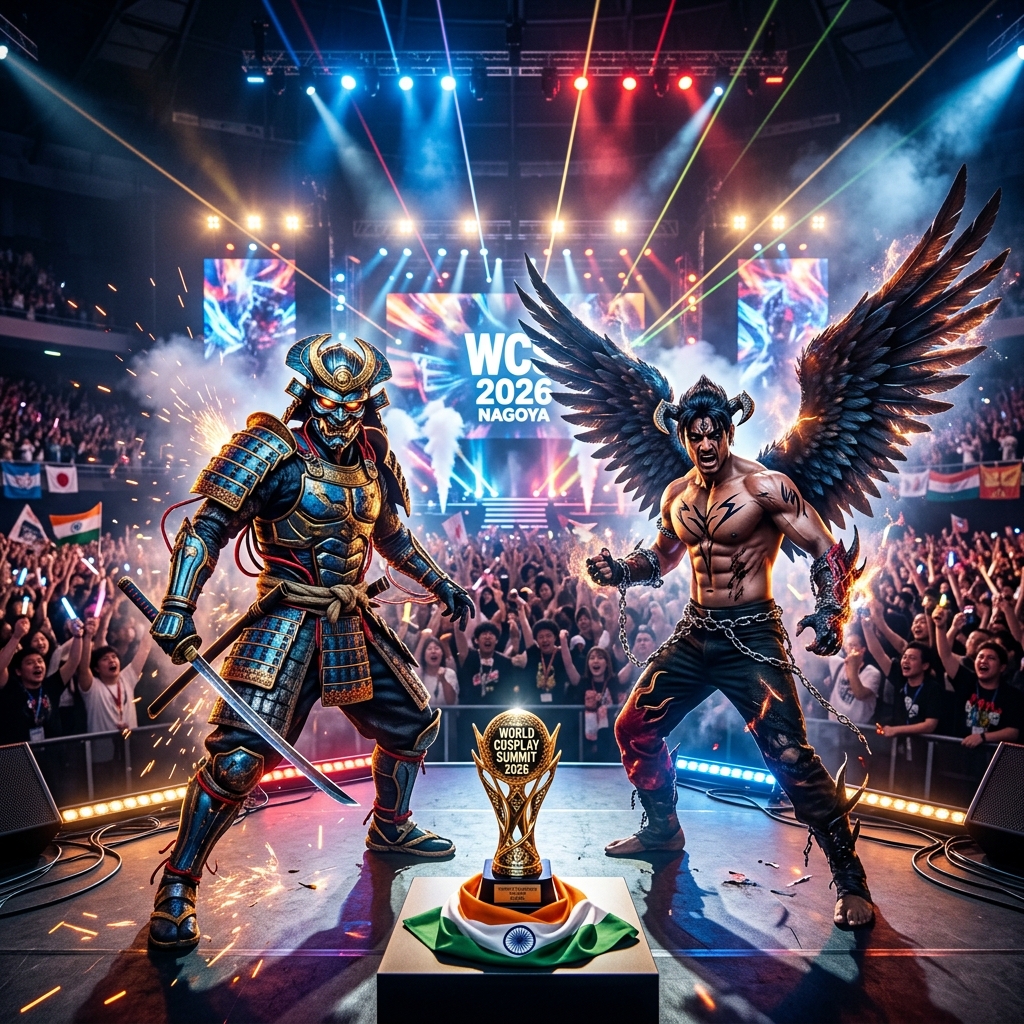
There's a photograph going around in the Indian fandom community right now. Two guys. Nagoya, Japan. One dressed as Yoshimitsu — that wild, samurai-spirited nightmare from Tekken — with hand-etched armor, 3D-printed pauldrons, and a glowing mask that looked like it had no business existing outside a PS5. The other: Devil Jin. Wings spread. The dark energy of the character somehow radiating even through a static image.
These are Karan Desai and Karan Prakash. And earlier this month, they walked onto the World Cosplay Summit 2026 stage in Nagoya as India's representatives — and they walked off with the ZIPAIR Next Journey Award, one of the summit's most prestigious recognitions.
If you haven't heard about this yet, don't feel bad. Indian mainstream media barely covered it. But in the cosplay world, in the fandom corners that most people outside this community never find, this was a big deal. A genuinely, legitimately big deal.
How It Actually Happened
Let's back up for a second.
The World Cosplay Summit, for those who don't know, is basically the Olympics of cosplay. Countries send their best pairs. They're judged on craftsmanship, performance, stage presence, and their ability to actually become the character — not just wear the costume. Forty-three countries competed in Nagoya this year. Forty-three.
India's road to getting there ran through Kolkata Comic Con in April 2026. Karan and Karan (yes, same first name — reportedly the source of endless jokes between them) won the national qualifier there, besting some genuinely impressive local competition to earn their spot representing the entire country in Japan.
What they chose to perform as was interesting. Yoshimitsu and Devil Jin from Tekken. Not the most obvious choice — these aren't the softest, "cutest" characters that tend to win on visual appeal alone. They're complicated, layered characters. Yoshimitsu especially is this ancient, honorable swordsman wrapped in tech-armor, equal parts warrior and ghost. Devil Jin carries the weight of Kazuya's bloodline, the Mishima curse, the whole conflicted legacy of the franchise.
Pulling those characters off convincingly requires more than a good 3D printer. It requires understanding what the characters mean. Based on what the judges said — and based on the award they received — Karan and Karan clearly did their homework.
What the Costumes Actually Were
Here's where I want to slow down and give proper credit, because the craftsmanship side of this story deserves its own moment.
Karan Desai's Yoshimitsu build reportedly combined handcrafted armor panels, detailed embroidery work (a nod to the feudal Japanese aesthetics of the character), 3D-printed structural components for the helmet and shoulder pieces, and extensive prop-making for the sword. This wasn't store-bought. This wasn't commission-it-from-overseas. This was built — apparently largely in a home workshop, over months.
Karan Prakash's Devil Jin was similarly layered. The wings alone are an engineering challenge that most cosplayers either skip entirely or approximate with foam and hope. The devil-transformation detail — the split between Jin's human form and his cursed inheritance — required a costume that had to read clearly from the back of a large auditorium stage.
Both costumes had to survive the travel from India to Japan intact. Anyone who has carried handmade props across an international flight knows the specific anxiety that involves.
They did it. And it showed on stage.
Why This Feels Different
India has been sending cosplayers to international competitions for years now. We've had good showings. We've had memorable performances. But there's been a gap — not in passion or skill, but in international recognition.
This WCS award feels like something shifted.
Part of it is probably timing. The Indian fandom community has spent the last five or six years quietly building infrastructure that didn't exist before — Comic Cons across multiple cities, YouTube channels with serious production value, Instagram accounts that rival professional cosplay photographers anywhere in the world, and communities online that actually support each other's work instead of tearing it down.
Karan and Karan didn't emerge from nowhere. They came from that ecosystem. The Kolkata qualifier they won wasn't a small local event — it was organized, competitive, and genuinely difficult to win. The fact that their path ran through Kolkata Comic Con matters. It's a reminder that the events that Indian fans sometimes dismiss as "just Comic Con" are producing world-class competitors.
The other part of why this feels different is the category itself. The ZIPAIR Next Journey Award isn't a consolation prize for promising newcomers. It recognizes cosplayers who demonstrate exceptional potential and a distinct artistic vision. It's a statement about where these two are going, not just where they've been.
What Happened to the Grand Championship?
Worth mentioning briefly: the overall Grand Champion title at WCS 2026 went to Team Hong Kong — Ar Lu and Ronnie Kui — for their Monster Hunter performance. By all accounts, it was extraordinary. Monster Hunter cosplay has been having a serious moment globally, and their execution was reportedly flawless.
India didn't take the top prize. But that framing misses the point.
Forty-three countries showed up. India walked away with a major award. In a competition built around craftsmanship, performance, and character understanding — the three things that are hardest to fake — two guys from Kolkata were recognized by international judges as among the best in the world at what they do.
That's not a consolation story. That's a story about a community that's been putting in the work for years finally showing up on the world stage.
The Bigger Picture for Indian Fandom
Here's something worth sitting with: this achievement didn't happen in isolation. It happened in the same year that Anime India expanded to Kolkata with 40,000+ attendees expected. In the same year that Shueisha launched Manga Million, their attempt to put manga in front of 100 languages worth of readers globally — and Indian readers are a significant part of that calculation. In the same year that Indian creators are building original manga, webcomics, and indie comics that actually compete aesthetically with international work.
The Indian fandom isn't consuming anime and manga from the outside anymore. It's participating. It's creating. It's competing. And, now, it's winning.
That shift matters for reasons beyond trophies. It means there's an audience here — a real one, not just passive viewers — for original Indian stories told in the visual language of manga and comics. Stories that don't have to mimic Japanese aesthetics to be valid, but can draw from them, remix them, and create something that feels genuinely new.
Speaking of Original Indian Comics
We'd be doing a disservice not to mention: this is exactly the kind of creative energy that ZealPlane was built for.
If the story of Karan and Karan resonates with you — if you find yourself thinking about what it means to take a craft seriously, to spend months building something real, to show up at the highest level — then you might also find yourself wanting to read stories made with that same energy.
Karma, one of the original titles on ZealPlane, is worth your time. It's an Indian manga — a story rooted in this country's mythology and emotional landscape, drawn with the visual grammar of manga, and telling a story you won't find anywhere else. The people who made it are doing the same thing Karan and Karan did: taking something they love, putting in the work, and making it real.
PRANA, another original title on the platform, goes even further into Indian mythological territory, with art that doesn't apologize for its ambitions.
These aren't perfect. They're indie. But they're genuine — made by Indian creators, for readers who are tired of waiting for someone else to tell their stories.
What Comes Next
For Karan and Karan: probably a few weeks of well-deserved rest before the Indian cosplay community starts asking them to appear at everything, everywhere, all at once. The Nagoya win will open doors. Good doors.
For the Indian fandom more broadly: this is a data point. A proof of concept. A moment to point to the next time someone asks whether India "can really compete" in creative fields that have traditionally been seen as belonging to Japan, Korea, or the West.
It can. It did. And the infrastructure — the Comic Cons, the online communities, the platforms for original creators — is only getting better.
For One Piece fans sitting here wondering when Chapter 1191 drops: August 23rd. The week's break is painful. We feel it too.
The photograph of two guys from Kolkata standing on a stage in Nagoya, in costumes they built themselves, holding an award — that image is going to be around for a while. Not because it went viral on Instagram. But because the people who were in that room, and the community that raised them, know what it cost and what it means.
That's usually how the important moments actually feel.
Featured Original Indian Indie Comics on ZealPlane
Explore original indie comics available free to read online:
Trending Indie Webcomics & Manga
- Read Chullu aur Lootera Bhoot online free
- Read My most favorite gags of Guddu online free
- Read Chullu aur Khadoos uncle online free
- Read Animocity Review online free
- Read When horror meets humour online free
- Read THE GIRL INSIDE THE CUPBOARD online free
- Read वज्रयोद्धा By Magha Studio online free
- Read Read 'GHOST IN THE CROWD' by Prince Ayush online free
Latest Pop Culture & Comic News
- One Piece Chapter 1195 Spoilers: Release Date, Global Schedule, and Early Elbaph Hints
- Are Demon Slayer's Breathing Techniques Actually Real — Or Just Visual Flair?
- Spider-Man Is Doing Luffy's Gear 2 Pose, and Fans Are Rightfully Losing It
- Spider-Man Is Doing Luffy's Gear 2 Pose, and Fans Are Rightfully Losing It
- The Ultimate Webtoon Canvas Size & Slicing Guide (2026): How to Format, Slice, and Publish Without Quality Loss
- Beyond Squid Game and Alice in Borderland: 5 Death Game Stories That Actually Get Under Your Skin