Why Super Commando Dhruva Is Impossible to Defeat — And What It Teaches You About Your Own Mind
By Krishna Kumar | Senior Pop Culture & Manga Analyst | ZealPlane Chronicles

His enemies have said it themselves.
Chumba — a supervillain who can control metal and magnetism with a thought — admitted that Dhruva scares him in his dreams. Dr. Virus, who went toe-to-toe with Nagraj and Parmanu, shifted his entire base of operations from Rajnagar to Delhi — not because he was beaten, but because he did not want to face Dhruva. Mahamanav, a being so far beyond human evolution that comparing him to a regular person is like comparing a human to a monkey, chose to kill Dhruva himself rather than send a pawn — because Dhruva was the only one he considered worth killing personally.
And Nagraj — India's most powerful superhero, a man with the power of a thousand snakes — when once trapped inside an enemy's cage with no apparent escape, did not think of his own powers. He thought: "What would Dhruva have done, had he been in my place?"
Super Commando Dhruva has no superpowers. No mutation, no radiation accident, no divine gift. He is a 23-year-old from a circus with a utility belt, a motorbike, and a handful of star-blades. He has never once taken a human life. He works within the law, every single time, even when it costs him.
And yet — he is considered the most dangerous superhero in the Raj Comics universe.
Not despite his limitations. Because of how he has built himself around them.
This is not an article about a comic book character. It is about the mental system that makes a person impossible to defeat — and how that system, piece by piece, can be applied to your own life.
1. Reframe the Constraint — The Suprema Bomb
In the comic Suprema, Grand Master Robo plants a bomb on a man and gives Dhruva and Black Cat exactly two minutes.
The trap is airtight. The man carrying the bomb will follow them wherever they run — they cannot escape. They cannot attack him directly because his armour protects him from external explosions. They cannot disarm the bomb in time. Every conventional option leads to the same outcome: people die.
Black Cat is a lethal, experienced fighter. She sees a threat and thinks about how to neutralize it. Dhruva sees a puzzle and asks a different question entirely.
"If his armour can prevent explosions from the outside — can it contain an explosion from the inside?"
He doesn't get more time. He doesn't get better tools. He doesn't wait for backup. He takes the same information everyone else in the room has access to and asks a question nobody else thought to ask. Then he puts the bomb inside the armour.
Problem solved. In under two minutes.
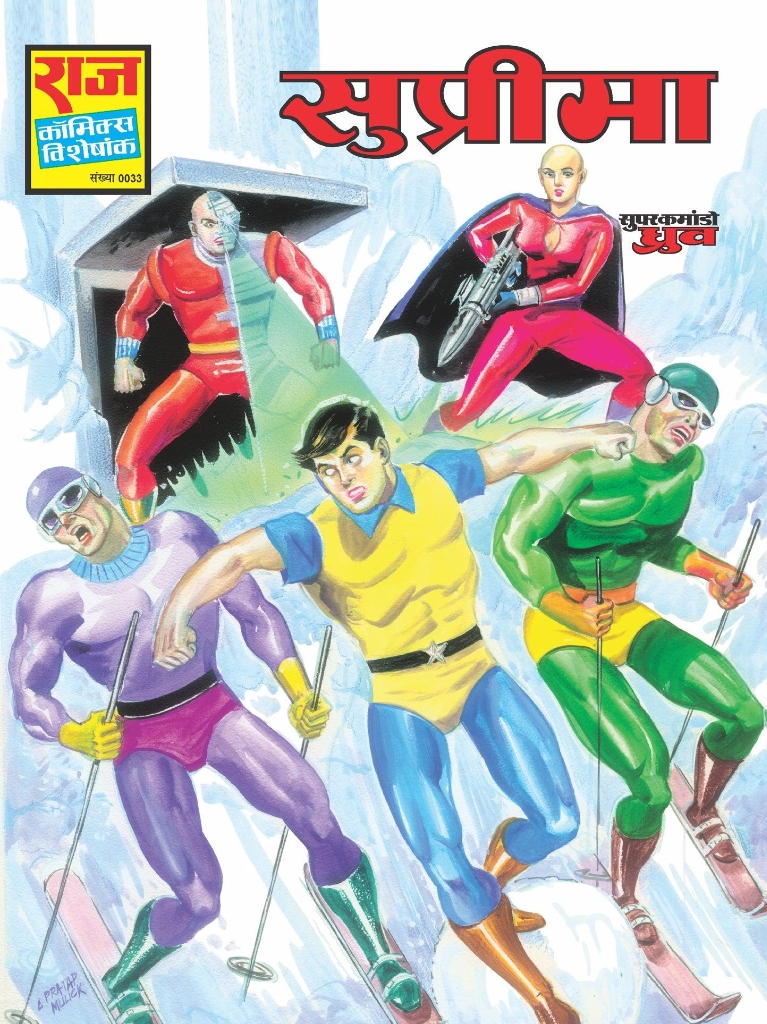
The principle: Constraint Inversion
Most people treat a problem's limiting factor as the reason they cannot solve it. Dhruva consistently treats the limiting factor as the mechanism of the solution. The armour was the obstacle. The armour was also the answer. They were the same thing — the difference was only in how the question was framed.
The real-world application:
The next time you face a problem where the constraint feels like the wall — ask what happens if the constraint becomes the tool. The budget you don't have forces the creativity that a bigger budget never would have produced. The competitor who dominates your market shows you exactly which customers they're ignoring. The limitation that seems to block you is often pointing directly at the solution, if you ask the right question.
This is what engineers call first-principles thinking. Strip away assumptions. Look at what is actually physically true about the situation. Then build your answer from there, not from convention.
2. The Environment Is Your Arsenal — The Cola Bottle, the Potato, and the Physics of Everything
When cornered with no conventional tools available, Dhruva used a cola bottle as an explosive.
In Dhruva Shakti, he used a potato to stop a car.
A potato. To stop a car.
These are not lucky accidents or comic book convenience. They are the visible output of a single, consistent, deeply trained cognitive habit: Dhruva does not see objects. He sees physics, chemistry, and mechanical properties — and he maintains that model of the world in real time, updated constantly, applied instantly when the situation demands it.
When he looks at a cola bottle, he does not see a drink. He sees pressurized liquid in a sealed container with a predictable failure point. When he looks at a potato, he does not see food. He sees a dense, compressible object with specific friction and structural properties that, placed correctly, can jam a mechanical system. When he looks at any room he enters, he is already running a background calculation: what here can be used, redirected, or repurposed if this situation turns dangerous?
Spanish columnist Chris Wright described this as "a MacGyver-like ability to use a paper clip or soup spoon to defeat enemies." But MacGyver is the pop culture shorthand. What Dhruva is actually doing has a more precise name.
The principle: Environmental fluency — the ability to read any situation as a resource map, not a fixed landscape.
Most people see environments as context — the background their actions happen against. Dhruva sees environments as active participants in any problem he's solving. The street, the room, the objects present, the physics of what surrounds him — all of it is live material. This is only possible because he has done the underlying work: he genuinely understands basic physics, chemistry, and mechanics well enough that his brain applies them automatically, without conscious effort, under pressure.
This is not improvisation in the casual sense of "making it up as you go." It is improvisation in the jazz musician's sense — a deeply rehearsed mastery of fundamentals that allows real-time recombination in novel situations. A jazz musician can improvise because they have internalized music theory so completely that they no longer have to think about it. Dhruva can improvise weapons from potatoes and cola bottles because he has internalized physics so completely that he no longer has to think about it.
The cola bottle works because he understands pressure dynamics. The potato works because he understands friction, density, and mechanical interference. The armour solution from the previous section works because he understands that containment is directional. Every "impossible" solution traces back to the same foundation: genuine understanding of how things actually work, maintained constantly, applied without hesitation.
The real-world application:
There are two separate things to take from this, and both matter.
The first is to build genuine depth in the fundamentals of your domain — not the surface vocabulary, not the current best practices, but the underlying principles that explain why things work. In any field, the person who understands the underlying physics (literal or metaphorical) of their domain will always find solutions that the person with only surface knowledge cannot see. The cola bottle is invisible to someone who only knows "bottles contain liquid." It becomes a tool the moment you understand pressure.
The second is to stay current. Dhruva is explicitly described in the comics as someone who is constantly updating his knowledge — new sciences, new technologies, new developments. His environmental fluency isn't a static skill he learned once. It's a living model of the world that he actively maintains. This is what allows him to use a contemporary object like a cola bottle as naturally as any traditional tool — because he has already mentally catalogued what it can do before the situation requires it.
Ask yourself: in your domain, do you know the fundamentals deeply enough that you could solve a problem using only what's physically in front of you? If the answer is no — that is the gap to close. Not more tactics. More fundamentals.
3. Change What Winning Means — Dracula's Volcano
In Dracula ka Ant, Dhruva faces an enemy who has achieved genuine immortality. Dracula cannot be killed. His body regenerates infinitely from any injury — which means every conventional strategy for defeating a villain is categorically unavailable.
Dhruva cannot win this fight. Not by the normal definition of winning.
So he changes the definition.
If Dracula cannot be destroyed, he can be contained in a state of permanent harmlessness. Dhruva throws him into a volcano. Dracula's body burns. It regenerates. It burns again. It regenerates again. Forever.
The immortality that made Dracula undefeatable becomes the mechanism of his permanent defeat. The very power that was supposed to make him unstoppable now traps him in an endless loop he can never escape. He is alive — which is exactly what he wanted — and completely unable to affect the world ever again.
“Dhruva did not beat Dracula. He made Dracula irrelevant.”
The principle: Redefine success criteria when the original game is unwinnable.
Most people, when facing an opponent they cannot beat directly, try harder at the same approach. They fight the enemy's immortality with more force, more weapons, more resources — and lose more comprehensively each time. Dhruva refuses to play a game he cannot win. He changes the game.
This is not giving up. This is strategic intelligence operating at its highest level. Sun Tzu wrote that the supreme art of war is to subdue the enemy without fighting. Dhruva doesn't fight Dracula's immortality — he makes it a prison.
The real-world application:
When you are in a competition you cannot win on the current terms — change the terms. A small business cannot out-resource a giant corporation on advertising spend. But it can redefine the game as "who knows their customers most personally" and win that version completely. A job applicant cannot out-credential someone with twenty more years of experience. But they can redefine the interview as "who has the clearest vision for the next three years" and make experience irrelevant.
Ask: what version of this situation can I win? Then play that version instead.
4. Make Your Identity Unbreakable — Mahamanav's Mental Assault
Mahamanav is not a villain in the conventional sense. He is an evolved being — so far beyond ordinary human capability that the comparison is explicitly made in the comics: as far beyond a person as a person is beyond a monkey. His mental powers are categorical, not incremental. He does not merely overpower minds. He rewrites them.
Against every other hero he encounters, this works.
Against Dhruva, it does not.
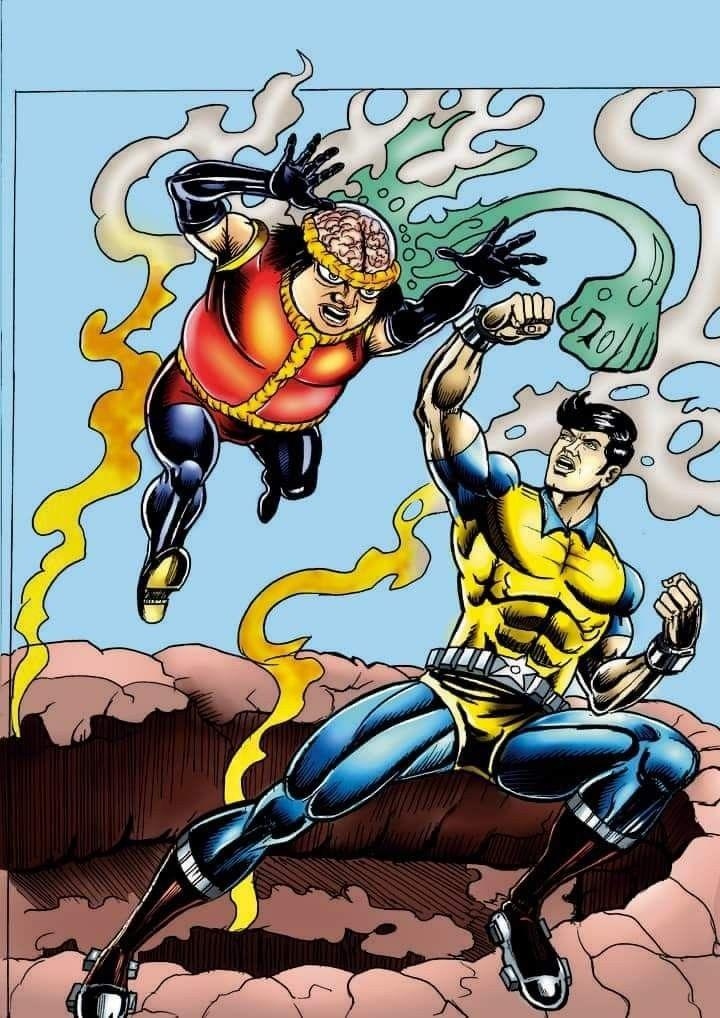
Not because Dhruva has a psychic shield. Not because he has a counter-power. But because his sense of self — his values, his identity, his moral code — is so completely integrated that there is no gap for the mental attack to enter through. Manipulation requires a gap between who you are and who you can be convinced to be. Dhruva has closed that gap so thoroughly that the most powerful psychic in the Raj Comics universe cannot find purchase.
He withstands it through sheer willpower. And then he keeps fighting.
The principle: Identity coherence is armor.
Robert Cialdini's decades of research on influence and persuasion reveal that every manipulation technique — from advertising to cult recruitment to political propaganda — works by exploiting the gap between your stated values and your actual behavior. The manipulator finds that gap and widens it, using your own inconsistency against you.
The defense is not a counter-technique. The defense is closing the gap — becoming a person whose actions so consistently match their values that there is nothing to exploit.
The real-world application:
Know exactly who you are and act like that person in every context — at work, at home, under pressure, when nobody is watching. The person who is the same in every room has nothing to hide and nothing to protect. They cannot be threatened with exposure because there is nothing to expose. They cannot be manipulated through their inconsistencies because they have none.
This is not rigidity. It is integration. Dhruva has a sense of humor, genuine relationships, moments of doubt — but his core values never waver under external pressure. That stability is what Mahamanav's power could not penetrate.
5. The Body Follows the Mind's Decision — The Himalayas
In Nagraj aur Bugaku, Dhruva is thrown into the Himalayas — one of the most hostile environments on earth. Extreme cold. No shelter. No equipment. Physiologically, survival is not supposed to be possible.
Dhruva survives through willpower alone.
This is the comics expressing something that sports science and extreme survival research have repeatedly confirmed: the body's physical limits are set, in large part, by the brain — not by the body itself. The brain imposes shutdown well before actual physiological failure, as a protective mechanism. This is what researchers call the central governor theory — the idea that exhaustion, pain, and cold are partly neurological experiences, not purely physical ones.
When the mind has genuinely accepted that stopping is not an option — not as a motivational statement, but as a real, committed decision — the body continues past its own default limits. Explorers, soldiers, and survivors have documented this consistently across history. People have survived objectively impossible cold, blood loss, and physical trauma when their mental framework treated survival as non-negotiable.
Dhruva's Himalayan survival is not magic. It is the comics being physiologically accurate about what human willpower, at its maximum, actually looks like.
The principle: Your perceived limit is not your actual limit.
The first signal to stop is almost never the real limit. It is the brain's conservative estimate of the risk of continuing. In most real-world situations — physical training, creative endurance, emotional resilience — the gap between "where the brain says stop" and "where the body actually fails" is significant.
The real-world application:
This does not mean ignoring genuine injury or destroying your health. It means learning to distinguish between the brain's protective signal ("this is uncomfortable and might get worse") and actual failure ("this is genuinely beyond current capacity"). Most people stop at the first signal. The gap between where most people stop and where they could continue — with practice, with genuine commitment — is where almost all meaningful achievement lives.
When Dhruva was in the Himalayas, quitting was not in the option set. Remove it from yours and notice what becomes possible.
6. No Single Point of Failure — The No-Weakness Architecture
Every major superhero has a vulnerability. Kryptonite. Water. A specific frequency. An emotional attachment that can be weaponized. Villains build entire strategies around finding that one exploitable point and applying maximum pressure to it.
Dhruva has no such point.
No powers means no power-specific weakness. No alter ego means no secret identity to threaten. No kill rule means he cannot be baited into becoming the villain. No ego means he cannot be taunted into abandoning his strategy. His foster family is protected — but threatening them does not destabilize him, it clarifies his focus. Even his love for Natasha, which should be the obvious emotional lever, is complicated by the fact that Natasha is Grand Master Robo's daughter — meaning the villain who would most want to exploit that relationship is also the one who cannot, because hurting Dhruva would hurt Natasha.
His entire architecture has no clean entry point for an attack.
The principle: Diversified capability creates structural resilience.
The person whose entire career depends on one skill is one technological shift away from irrelevance. The business built on one customer is one contract cancellation away from collapse. The person whose self-worth is attached to one relationship is one loss away from complete identity crisis.
Dhruva's resilience is not accidental — it is the cumulative result of building in every direction simultaneously (physical, intellectual, moral, relational, institutional) so that no single removal collapses the whole structure.
The real-world application:
Map your own single points of failure. Where in your life, if one thing changed, would everything else become unstable? That is your kryptonite. Dhruva did not eliminate his — he never had one. But most people can identify theirs and begin building a parallel capability or relationship or resource that means the removal of any one thing does not collapse everything else.
7. Defeat Is Data — The Return Pattern
Dhruva loses the first encounter.
Almost every time, against a truly powerful new opponent, Dhruva loses the first encounter. Mahamanav. Chandakaal. Grand Master Robo's most significant schemes. The pattern is consistent enough to be a design choice by Anupam Sinha — not a narrative weakness, but a deliberate characterization.
Because what Dhruva does after losing is the point.
He does not try the same approach harder. He does not seek more power or better weapons. He studies exactly how he lost — what the opponent's mechanism was, what his own response failed to account for, what the physics of the situation actually were. Then he returns with a response built specifically for that opponent's specific mechanism.
This is not resilience in the motivational-poster sense. This is a deliberate cognitive protocol: loss as diagnostic tool, not as terminal event.
The principle: The quality of your response to failure determines everything.
Carol Dweck's research on growth mindset — one of the most replicated findings in psychology — shows that the difference between people who improve over time and people who plateau is not talent, effort, or intelligence. It is whether they treat failure as information or as verdict.
Dhruva treats every defeat as the most detailed brief he could receive about his opponent. By the time he returns, he knows things about that opponent that he could not have learned any other way.
The real-world application:
After every significant failure — a lost deal, a failed project, a relationship that ended badly — run a genuine post-mortem before you move on. Not to assign blame. Not to feel better. To extract the specific data the failure contained. What did you not know going in that you know now? What assumption turned out to be wrong? What would a different approach have looked like?
Dhruva goes back to fight Mahamanav with a specific counter built from the first loss. What specific counter are you building from yours?
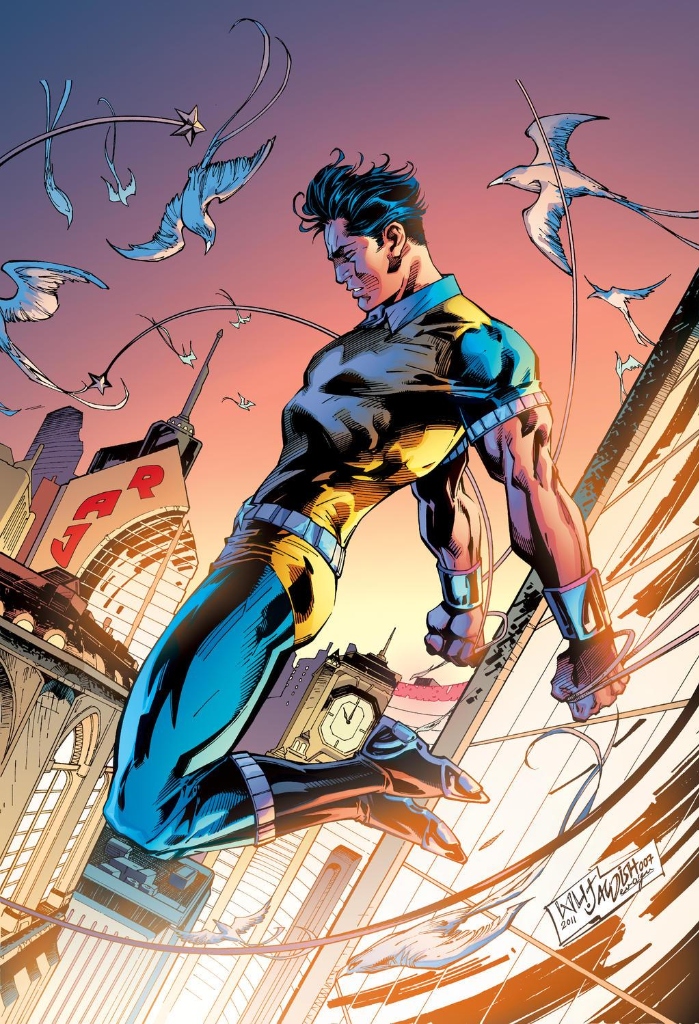
Why This All Adds Up to Something Impossible to Defeat
Anupam Sinha — Dhruva's creator — said something in a 2012 interview that contains the entire architecture of this character in one sentence:
"I wanted to show that a well-behaved and well-brought-up child should not fear being called a wimp."
Dhruva is not powerful in spite of his decency, his restraint, his refusal to kill, his cooperation with the police, his protection of enemies who have the potential to change. He is powerful because of those things. The moral code is not a limitation on his effectiveness — it is the source of it. It is what makes him unpredictable (he will not take the shortcuts his enemies expect). It is what makes his identity unbreakable (no gap between his values and his actions). It is what builds the network of reformed enemies that become his allies. It is what earns him institutional trust that no amount of superpower could purchase.
Every villain who has faced Dhruva long enough has arrived at the same conclusion: there is no angle to attack him from that does not eventually strengthen him.
That is not a superpower.
That is a system. And systems can be learned.
Super Commando Dhruva was created by Anupam Sinha and published by Raj Comics. If this piece made you want to explore Indian comics — start here on ZealPlane, where India's best indie comic creators are publishing right now.
Dive into Karma (an original comic written by me), read Sando ki Duniya by Fiction Comics, or explore the magical journey in Chullu Parilok Me by Swapnil Comics.
Discover Original Indian Comics on ZealPlane
If Dhruva's tactical genius and Indian graphic narrative heritage inspire you, explore original comics and classic indie treasures written and illustrated by Indian creators:
Karma
Written by Krishna Kumar. A dark fantasy epic where cosmic scales shatter when an unpayable soul enters the realm.
Sando ki Duniya
By Fiction Comics. Whimsical comedy adventures following Sando navigating quirky Indian neighbourhood dilemmas.
Chullu Parilok Me
By Swapnil Comics. A classic retro comedy tale featuring the beloved mischievous boy Chullu in the magical fairy realm.
Featured Original Indian Indie Comics on ZealPlane
Explore original indie comics available free to read online:
Trending Indie Webcomics & Manga
- Read Chullu aur Lootera Bhoot online free
- Read My most favorite gags of Guddu online free
- Read Chullu aur Khadoos uncle online free
- Read Animocity Review online free
- Read When horror meets humour online free
- Read THE GIRL INSIDE THE CUPBOARD online free
- Read वज्रयोद्धा By Magha Studio online free
- Read Read 'GHOST IN THE CROWD' by Prince Ayush online free
Latest Pop Culture & Comic News
- One Piece Chapter 1195 Spoilers: Release Date, Global Schedule, and Early Elbaph Hints
- Are Demon Slayer's Breathing Techniques Actually Real — Or Just Visual Flair?
- Spider-Man Is Doing Luffy's Gear 2 Pose, and Fans Are Rightfully Losing It
- Spider-Man Is Doing Luffy's Gear 2 Pose, and Fans Are Rightfully Losing It
- The Ultimate Webtoon Canvas Size & Slicing Guide (2026): How to Format, Slice, and Publish Without Quality Loss
- Beyond Squid Game and Alice in Borderland: 5 Death Game Stories That Actually Get Under Your Skin