JoJo’s Bizarre Adventure: Why Steel Ball Run Could Be the Series’ Biggest Anime Chapter Yet
By ZealPlane Anime Editorial | Senior Pop Culture & Manga Analyst | ZealPlane Chronicles
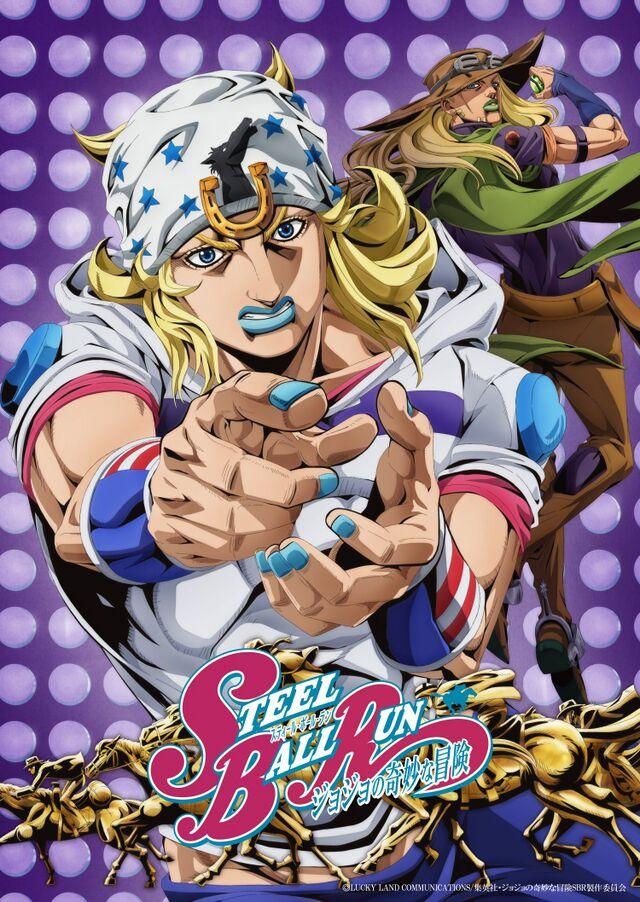
There are anime that become popular because they have a great story. There are others that become cultural landmarks because they look, sound and feel completely unlike anything else.
JoJo’s Bizarre Adventure has always belonged to the second category.
Hirohiko Araki’s long-running series has spent decades turning bizarre poses, extravagant fashion, supernatural battles and eccentric characters into one of manga’s most recognizable identities. But Steel Ball Run, the seventh major part of the story, is different even by JoJo standards.
And now, its anime adaptation is heading into its next major stage.
Netflix has confirmed that the 2nd STAGE of STEEL BALL RUN JoJo’s Bizarre Adventure begins streaming on September 25, 2026, with new episodes arriving weekly. The first stage consisted of a single 47-minute episode and is already available on Netflix.
For longtime JoJo fans, this isn't simply another season returning from a break. Steel Ball Run represents one of the most dramatic reinventions in the history of the franchise.
A completely different kind of JoJo story
At first glance, Steel Ball Run sounds almost nothing like the JoJo that came before it.
The story takes place in 1890s America, where riders from around the world enter an enormous horse race stretching from San Diego to New York. The prize is enormous. The journey is even more so. But this isn't really a sports story.
Behind the race are rivalries, strange supernatural abilities, political interests, hidden agendas and mysteries that gradually transform the competition into something much more dangerous.
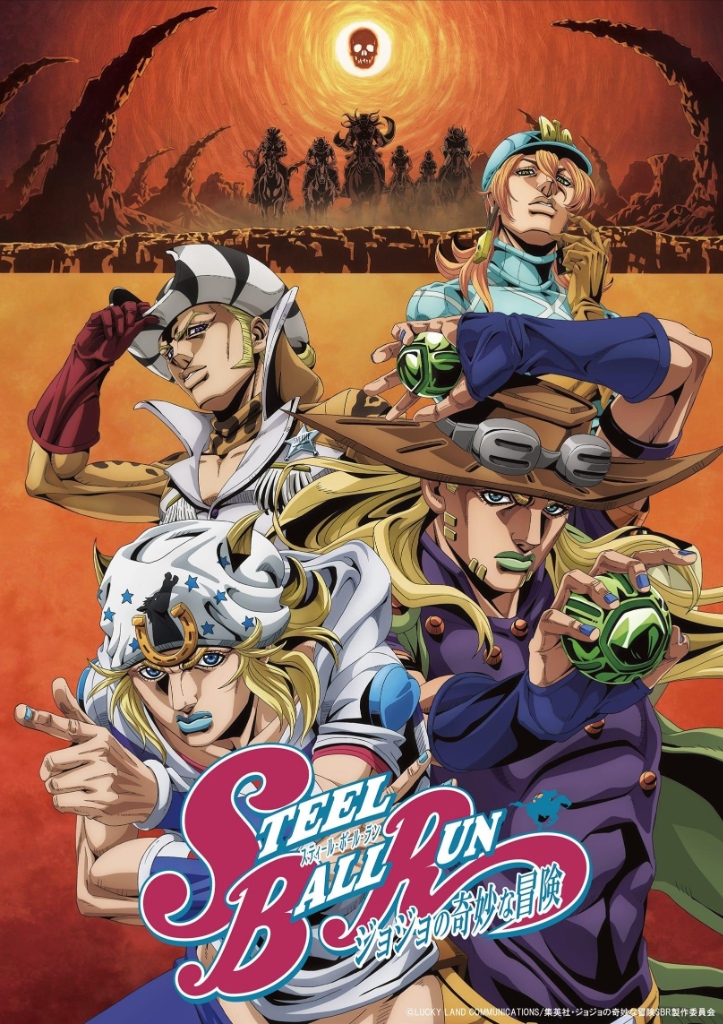 The central rivalry: Johnny Joestar, Gyro Zeppeli, and Diego Brando prepare for the cross-continent race.
At the center of it all is Johnny Joestar, a former jockey who has lost the use of his legs. Johnny isn't introduced as the confident hero audiences might expect from a JoJo protagonist. He is frustrated, damaged and searching for something that can give his life direction again.
Then he meets Gyro Zeppeli, an eccentric rider carrying a mysterious weapon known as the Steel Ball. That meeting changes everything.
Netflix's official synopsis describes Johnny as a former jockey who chases after Gyro while becoming involved in the brutal cross-continent horse race. And that setup is one of the reasons Steel Ball Run has such a different atmosphere from earlier JoJo stories.
The world is enormous. The characters are constantly moving. And danger can come from practically anywhere.
Johnny Joestar isn't simply another JoJo
One of the most interesting things about Steel Ball Run is its protagonist.
Johnny is not a straightforward hero. His physical condition is central to his character, but the story doesn't reduce him to it. Instead, his disability becomes part of a much larger personal struggle. He wants to move forward, literally and metaphorically.
The race therefore becomes more than a competition. It becomes a reason for Johnny to keep going. That gives the story an unusually personal emotional core for a JoJo adventure.
Gyro Zeppeli might steal the show
If Johnny provides the emotional center, Gyro provides much of the personality.
He is strange, confident, funny and often impossible to predict. His Steel Balls aren't merely weapons. They are connected to a technique known as the Spin, which becomes one of the defining ideas of the story.
That makes Gyro's fighting style fundamentally different from the Stand battles many viewers associate with JoJo. Instead of simply asking who has the stronger supernatural ability, Steel Ball Run repeatedly asks a more interesting question: Who understands their ability better?
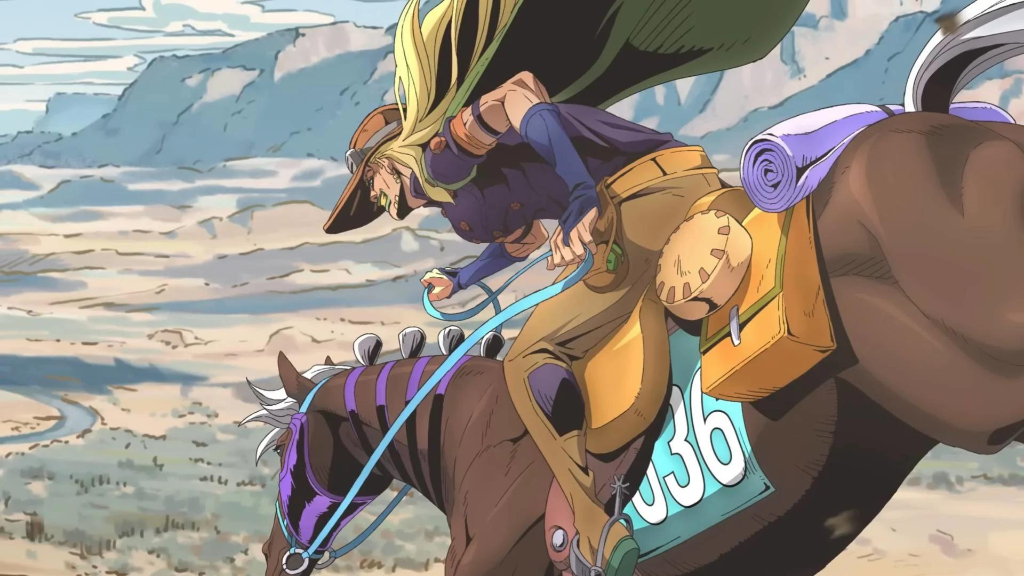 Gyro Zeppeli utilizing the Spin technique while racing through the American frontier.
That distinction is important. JoJo battles have always been about creativity rather than simple power levels, but Steel Ball Run pushes that philosophy particularly far. A seemingly ridiculous ability can become terrifying when its user understands exactly how to exploit it.
⚡ Discover Original Indian Visual Stories
If you appreciate the bold art and epic storytelling of JoJo, you will love diving into our original Indian indie comic series. Check out dark fantasy titles like Aghori, supernatural mysteries in Sando, or the action-comedy of Chullu. Read them entirely free, direct from the creators on our homepage.
Explore Comics Now →The American frontier becomes part of the story
Another reason Steel Ball Run feels so different is its setting. Earlier JoJo parts travelled through cities, islands, prisons and other highly distinctive environments. Here, enormous stretches of the American landscape become part of the adventure.
Deserts. Mountains. Open plains. Small settlements. Long stretches of road.
The race creates a natural structure for the story because every new location can introduce another competitor, another threat or another mystery. That also gives the anime an opportunity to do something JoJo has always done well: turn the environment itself into part of a fight.
A battle doesn't necessarily need an arena. Sometimes the entire landscape is the weapon.
And then there are the Stands
Of course, this is still JoJo. Eventually, the horse race becomes increasingly tangled with supernatural conflict. The Stand abilities in Steel Ball Run are among the series' strangest. Some are powerful. Some are bizarre. Some initially seem almost useless. And some become frightening precisely because their rules are so unusual.
This is where Steel Ball Run retains the DNA of classic JoJo.
Araki isn't particularly interested in creating battles where one character simply punches harder than another. Instead, the fights are puzzles. A character discovers the opponent's ability. The audience tries to understand its rules. Someone finds a loophole. The situation becomes worse. And then somebody produces an even stranger solution.
Why the Steel Ball Run anime matters so much
There is another reason this adaptation has attracted enormous attention. Steel Ball Run is not merely another chapter continuing the previous storyline. It begins a new continuity. That makes it an unusually accessible entry point for people who know JoJo only through its anime adaptations.
You don't need to approach it as though you are simply watching the next chapter of the same story. It is a new world with familiar ideas, familiar names and completely new circumstances.
The anime is being produced by David Production, the studio behind the previous JoJo television adaptations. The adaptation was announced in 2025, with the production team and principal cast subsequently revealed. The principal cast includes Shogo Sakata as Johnny Joestar, Yohei Azakami as Gyro Zeppeli and Kaito Ishikawa as Diego Brando.
Diego Brando is not simply a familiar name
One of the most fascinating aspects of Steel Ball Run is how it plays with ideas that longtime JoJo readers recognize. Characters may carry familiar names or echoes of personalities from previous parts, but they aren't simply carbon copies.
That creates a strange feeling throughout the story. You recognize something. Then Araki changes it. You think you understand where a character is going. Then the story takes a completely different direction. That balance between familiarity and reinvention is one of Steel Ball Run's greatest strengths.
When does Steel Ball Run return?
The 2nd STAGE of STEEL BALL RUN JoJo’s Bizarre Adventure begins on Netflix on September 25, 2026.
Unlike the first stage, which arrived as a single 47-minute episode, the second stage will release one episode each week, with 11 episodes scheduled for this stage.
That weekly schedule could be particularly interesting for JoJo. The series has always generated discussion around individual battles, characters and bizarre developments. A weekly release gives viewers time to speculate, argue over abilities and revisit details before the next episode arrives. And for a story as unpredictable as Steel Ball Run, that could become part of the experience.
Why new viewers should care
If you've never watched JoJo before, Steel Ball Run might sound intimidating. It's part seven. There are decades of JoJo history behind it. There are Stands, Spins, alternate versions of characters and an enormous amount of mythology.
But the most important thing to understand is surprisingly simple: you don't need to know everything to appreciate the premise.
At its heart, this is a story about a broken jockey who enters an impossible race, meets an extraordinary man named Gyro Zeppeli and gradually discovers that the race is connected to something much bigger.
It's an adventure story. It's a supernatural thriller. It's a Western. It's a road story. And, inevitably, it's completely bizarre. That combination is exactly why JoJo's Bizarre Adventure has survived for so long.
The real question isn't whether Steel Ball Run will be popular
JoJo already has an enormous global audience. The more interesting question is whether the anime adaptation can make Steel Ball Run reach people who never previously considered themselves JoJo fans.
The premise certainly gives it a chance. A cross-country horse race in 1890s America is immediately understandable. Johnny and Gyro provide a compelling central relationship. The supernatural elements give the story the strange identity fans expect from JoJo. And the weekly Netflix release gives the series an opportunity to become a recurring conversation throughout the latter part of 2026.
If the adaptation manages to capture the atmosphere of Araki's original work, Steel Ball Run could become much more than another successful JoJo adaptation. It could become the point where an entirely new generation discovers why this bizarre adventure became one of manga's most enduring phenomena.
September 25 is when the next stage begins. And considering what Steel Ball Run eventually becomes, the race has only just started.
Featured Original Indian Indie Comics on ZealPlane
Explore original indie comics available free to read online:
Trending Indie Webcomics & Manga
- Read Chullu aur Lootera Bhoot online free
- Read My most favorite gags of Guddu online free
- Read Chullu aur Khadoos uncle online free
- Read Animocity Review online free
- Read When horror meets humour online free
- Read THE GIRL INSIDE THE CUPBOARD online free
- Read वज्रयोद्धा By Magha Studio online free
- Read Read 'GHOST IN THE CROWD' by Prince Ayush online free
Latest Pop Culture & Comic News
- One Piece Chapter 1196 Spoilers: Sanji Awakens Conqueror’s Haki as Oda Finally Solves His Biggest Character Flaw
- Kagurabachi Anime Confirmed: World Tour Premiere, Release Schedule, and Where to Read the Manga
- Masashi Kishimoto Is Drawing Naruto Again. Here's Everything We Actually Know.
- सुपर कमांडो ध्रुव को हराना नामुमकिन क्यों है? (और यह आपके दिमाग के बारे में क्या सिखाता है)
- 2026 में भारतीय कॉमिक्स ऑनलाइन कहाँ और कैसे पढ़ें? (राज कॉमिक्स, Pratilipi, ToonSutra और नए विकल्प)
- One Piece Chapter 1195 Spoilers: Release Date, Global Schedule, and Early Elbaph Hints